VIMOUTIERS of  the  Pays d'Auge  in  NORMANDY

Home

Website map

Miscellaneous

Market Place

Religious

Buildings

Events

La Vie, the river

Overall pictures

Surroundings

Unclassifiable

Maps

OLD PICTURES - VINTAGE CARDS

Unclassifiable


In search of lost time : Best viewed full-screen, click pictures then enlarge.


Norman scenes ... and more


<bgsound src="sn/mn.wav" loop= "1 ">

On-line translators : texts of the "pop-ups" at the bottom of this page


" GRAND BAZAR DE VIMOUTIERS - FIXED PRICE - FREE ENTRANCE "


But whom does this inovative concept of "fixed price and free entrance" come from .... that's it, from a Norman pioneer !

"Born in 1810 in the Orne region in France, Aristide Boucicaut son of a hat maker in Belleme, decided one day to leave his childhood village and try to find customers along the roads of Normandy. After seven years of selling wool and cretonne, he reached Paris, where he became a drapper's assistant at the "Petit Saint Thomas" ... There he meet the sweet Marguerite, a lovely dairywoman who became his wife ... After the crisis of 1848, Aristide became unemployed and he approached the Videau brothers who owned the "Bon marché" a small business in the rue du Bac. They became partners but the Videau brothers were taken aback by Aristide's bold commercial ideas and very soon sold him their share in the business ...

With the support of his wife, Aristide embarked on transforming the stall into what would become the very first department store where one could stroll pleasantly ! He invented the concept of fixed price, clearly indicated on labels, no need to haggle ! Fortune smiled upon the Boucicauts who soon became one of the most famous pairs of their time ..."


Perhaps you didn't know that in his novel Au Bonheur des Dames/Ladies' Delight, a part of the Rougon-Macquart, Emile Zola created his character named Octave Mouret from Aristide Boucicaut !


Goodness, Boucicaut did it this way in Paris, why won't we do the same in Vimoutiers !


Seriously, Boucicauts gave a part of their fortune to charity organizations, they helped Pasteur and founded the Hopital Boucicaut in Paris.


So there ... enjoy shopping !

Sources Histoy of Le Bon Marche

Aristide Boucicault


Monnaie de nécessité


The First World War having disorganized the Economy, the French State tolerated the use of a local currency emitted by Chambers of Commerce, municipalities and some tradesmen…

These currencies took various forms, initially made out of cardboard, then soon stroke tokens… provided that they were marked “Good For” in order to distinguish them from the official currency… so quid of those?!


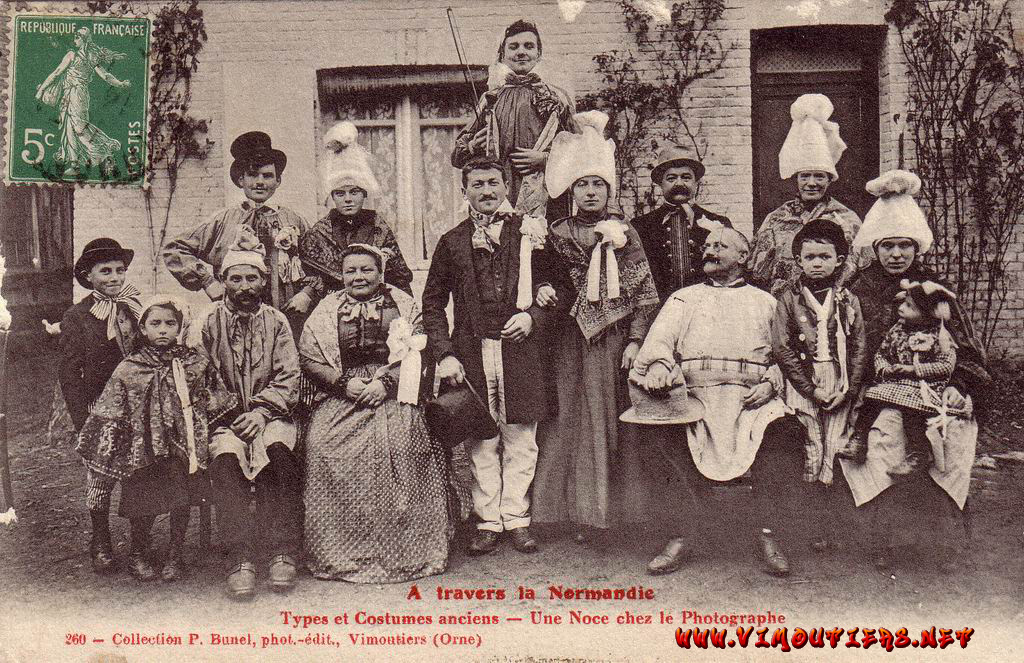
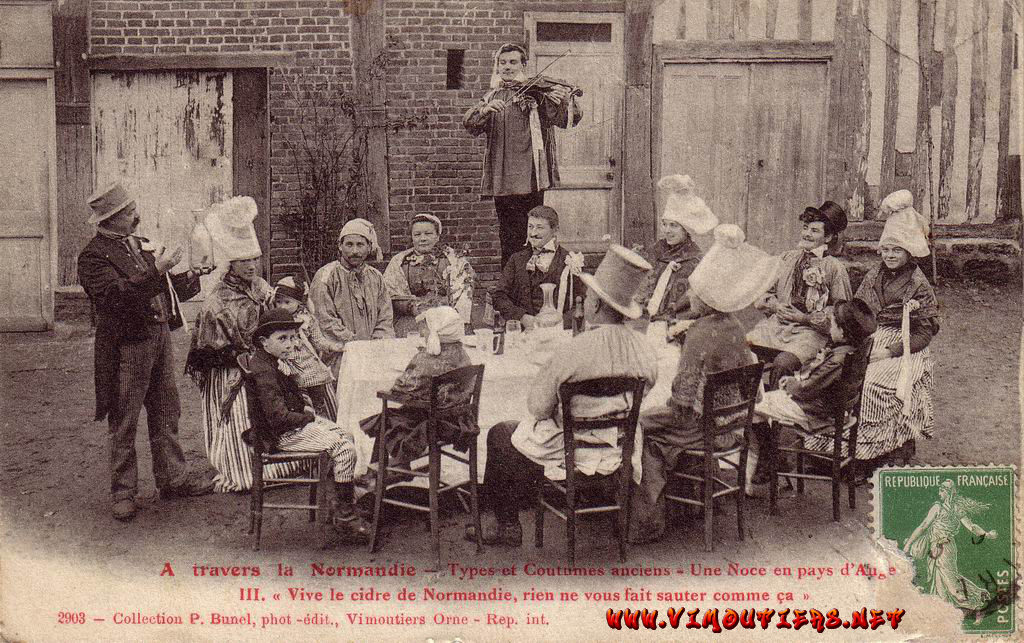
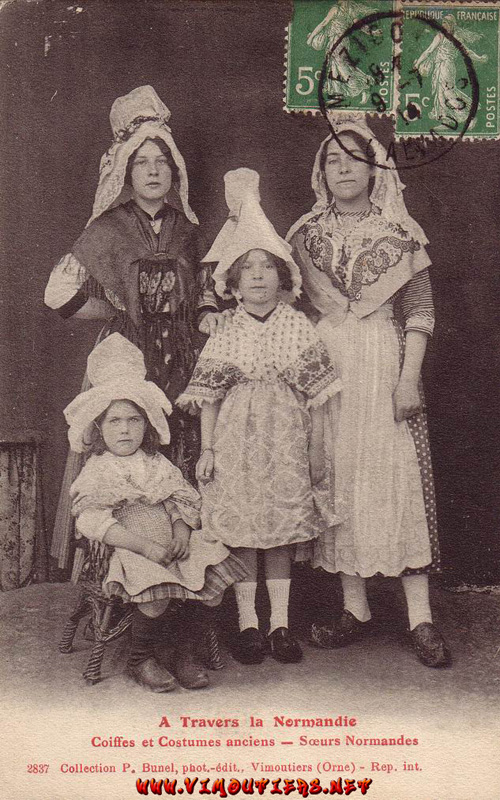
"The great vogue of the cotton bonnet started towards the end of the XVIIe century, but it is then a middle-class hairstyle, for night... Middle-class men often cover it with an envelope of fabric which they tie and adorn with a node of tinted ribbon, like Argan in the Hypochondriac (Le Malade imaginaire by Moliere)... However the cotton bonnet was soon adopted by craftsmen and Norman peasants were to adopt it in their turn, towards the middle of the XVIIIe century... For the man working in fields, it is an adherent hairstyle which one can double, tightening the head well, covering the ears and preserving them against intense cold. Under the first Empire, the cotton bonnet was in such a favour that Norman women adopted it also with pleasure. That did not prevent from wearing the beautiful caps... on Sundays.


young girl in mourning

The cotton bonnet which the female coquettery would enjoliver, was then so very fashionable that women wore it ... even in Churches! The clergy protested against this negligence in the behaviour and fulminated against the cotton bonnet, qualified as an "abominable hairstyle".


As well in this time, there were in Normandy two parties ...

 Pros and cons


"For cotton bonnet"

Yes


 "Against cotton bonnet"

No


Visitors via online translators : translation of the pop-up


How did men and women, especially all over Normandy, adopt this universal fashion of the "pacific cascameche"? Well, because since old times, the cotton bonnet was manufactured in Falaise, which, before being the city of William-the-Conqueror, was the capital of the cotton bonnet !" Source G.Dubosc, 1929


On-line translators : texts of the "pop-ups" at the bottom of this page

A few lovely Norman Ladies !


Concentration !


click to reset the counter to 0 before playing


"You know, it is just that the domino game is the true Norman game, the game which is the most convenient to their temper, their customs and their proverbial sapience. Doesn't it enhance their qualities as well as their native virtues ? ...sustained attention, considered meditation, wise perceptiveness ..."

 Chronicle in "Journal de Rouen" newspaper, Sunday October 19th, 1924.


contact/webmaster

copyright©2005-08

Geo Visitors Map


Online translators : hereunder the text in the pop-ups   :


Text in French, click

Ma Normandie/My Normandy

- 1 -
When everything is reborn in hope
And winter flees far from us,
Under the beautiful sky of our France,
When the sun returns gentler,
When nature has turned green again,
When the swallow has returned,
I like to see once more my Normandy,
It’s the country where I saw the light of day.

- 2 -
I’ve seen the fields of Helvetia,
And its chalets and its glaciers,
I’ve seen the sky of Italy,
And Venice and its gondoliers.
EGreeting each homeland,
I told myself that no stay
Is finer than my Normandy,
It’s the country where I saw the light of day.

- 3 -
There comes a time of life,
When every dream must finish,
A time when the restful spirit
Needs to remember.
When my chilled muse
Makes its way back to the past,
I’ll go see once more my Normandy,
It’s the country where I saw the light of day.

Paroles et musique: Frédéric Bérat (1836)


Yes

OUI

Miss Amelie Bosquet, who was a lady and could have her own idea, wrote in “La Normandie illustrée” newspaper :

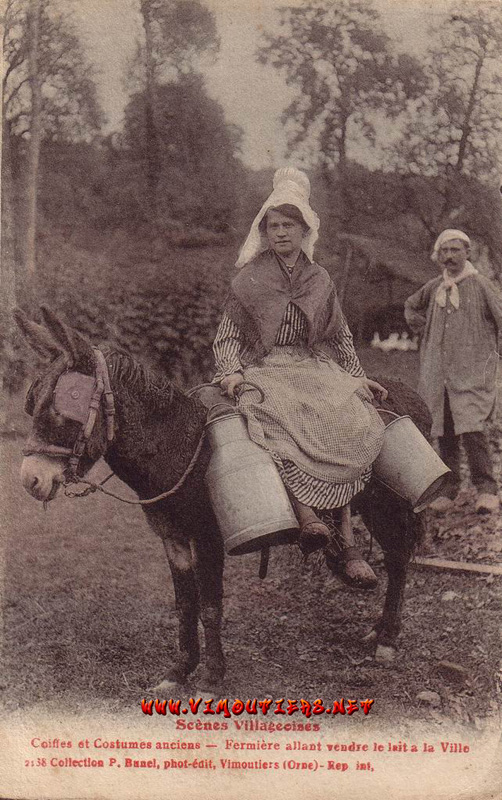
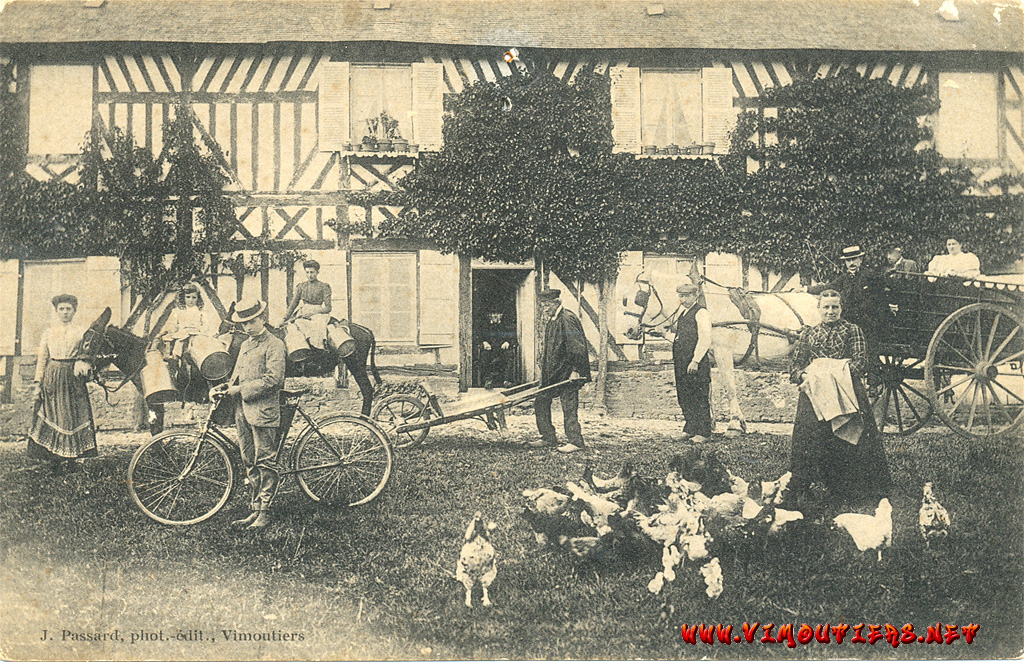
"Never cotton bonnet spoiled pretty faces and the young female farmers, the dairy ones on their donkeys, the engaging villagers going to the market, were even more attractive with this bonnet of a charming rusticity. All these white bonnets which did not fly away over the mills, in the middle of green lands, would offer on the contrary, an animated and happy cheerfulness to the country parties."


No

NO

But, Galleron, who also described Normandy, did not fear to say:

"The hairstyle of the women here is what strikes more the foreigner. He can see the cotton bonnet on almost all the heads: sometimes dirty and retaining unkempt hair which escapes in neglect, sometimes covered with a rather badly folded cap.

Women must have little self-esteem to preserve this fashion which deprives them of any grace. A Venus wearing a cotton bonnet would have difficulties in being looked at. Besides this hairstyle gives to a female face something of shameless, which disgusts involuntarily... There are even some women who wear brown or unbleached cotton bonnets ! ...
It is impossible to depict the unpleasant impression which one feel at the sight of such a hairstyle !"


g